kwcoco.metrics.confusion_measures module
Classes that store accumulated confusion measures (usually derived from confusion vectors).
- For each chosen threshold value:
thresholds[i] - the i-th threshold value
The primary data we manipulate are arrays of “confusion” counts, i.e.
tp_count[i] - true positives at the i-th threshold
fp_count[i] - false positives at the i-th threshold
fn_count[i] - false negatives at the i-th threshold
tn_count[i] - true negatives at the i-th threshold
- class kwcoco.metrics.confusion_measures.Measures(info)[source]
-
Dict-like container for accumulated confusion counts and derived metrics.
Holds accumulated confusion counts, and derived measures.
At minimum this class needs to be given an array of thresholds and corresponding arrays of FP, FP, TN, FN counts at each threshold. These are generally computed by
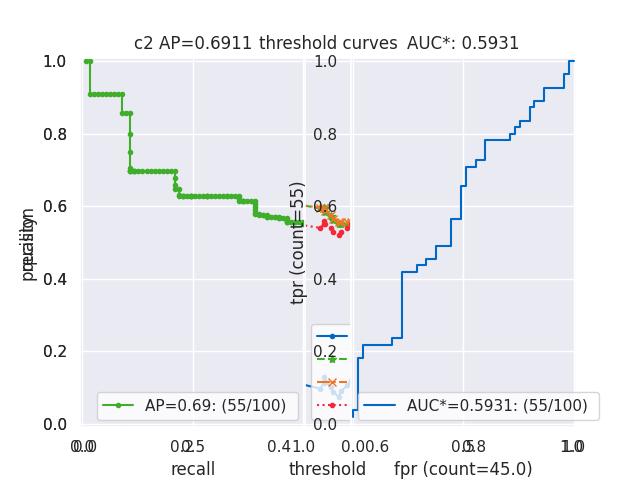
kwcoco.metrics.confusion_vectors.BinaryConfusionVectors. From there, other higher level metrics such as AP, AUC, max-F1, max-MCC etc can be computed.Example
>>> from kwcoco.metrics.confusion_vectors import BinaryConfusionVectors  # NOQA
>>> binvecs = BinaryConfusionVectors.demo(n=100, p_error=0.5)
>>> self = binvecs.measures()
>>> summary = self.summary()
>>> print(f'summary = {ub.urepr(summary, nl=1)}')
>>> print('self = {!r}'.format(self))
>>> # xdoctest: +REQUIRES(--show)
>>> import kwplot
>>> kwplot.autompl()
>>> self.draw(doclf=True)
>>> self.draw(key='pr',  pnum=(1, 2, 1))
>>> self.draw(key='roc', pnum=(1, 2, 2))
>>> kwplot.show_if_requested()
- property catname
Category name associated with these measures, if any (
nodekey).
- reconstruct()[source]
Recomputes derivable measures (e.g. AP, F1) from raw confusion counts.
- Returns:
Self
- summary()[source]
A concise dictionary with summary level information about the measures
- Returns:
dict
- maximized_thresholds()[source]
Returns thresholds that maximize metrics.
- Returns:
For each metric (e.g.,
"f1","mcc"), a dict with:{"thresh": float, "metric_value": float, "metric_name": str}.- Return type:
Example
>>> from kwcoco.metrics.confusion_measures import *  # NOQA
>>> self = Measures.demo()
>>> info = self.maximized_thresholds()
>>> print(f'info = {ub.urepr(info, nl=1, precision=2)}')
- scalars()[source]
Return the computed metrics without the full curve content
- Returns:
The underlying map with large arrays removed.
- Return type:
Dict
Example
>>> from kwcoco.metrics.confusion_vectors import BinaryConfusionVectors  # NOQA
>>> binvecs = BinaryConfusionVectors.demo(n=100, p_error=0.5)
>>> self = binvecs.measures()
>>> scalars = self.scalars()
>>> print(f'scalars = {ub.urepr(scalars, nl=1)}')
- counts()[source]
Just return the curves, from which most other data is computed (subject to metadata, see __json__ for actual minimal metadata)
- Returns:
kwarray.DataFrameArray
- draw(key=None, prefix='', **kw)[source]
Draw a specified metric curve using matplotlib.
- Parameters:
key (str | None) –
Noneor"thresh": threshold vs metric curves"pr": precision–recall curve"roc": ROC curve
prefix (str) – Label prefix for legends/titles.
**kw – Forwarded to the underlying drawing helpers.
Todo
[ ] Modernize these plots with seaborn
Example
>>> # xdoctest: +REQUIRES(module:kwplot)
>>> # xdoctest: +REQUIRES(module:pandas)
>>> from kwcoco.metrics.confusion_vectors import ConfusionVectors  # NOQA
>>> cfsn_vecs = ConfusionVectors.demo()
>>> ovr_cfsn = cfsn_vecs.binarize_ovr(keyby='name')
>>> self = ovr_cfsn.measures()['perclass']
>>> self.draw('mcc', doclf=True, fnum=1)
>>> self.draw('pr', doclf=1, fnum=2)
>>> self.draw('roc', doclf=1, fnum=3)
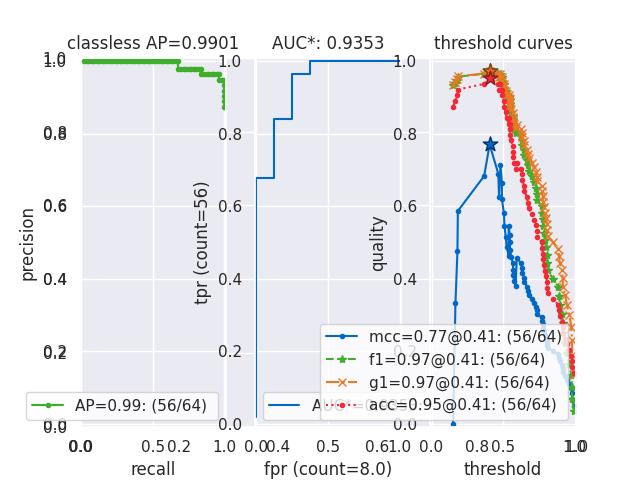
- summary_plot(fnum=1, title='', subplots='auto')[source]
Draws a figure with multiple metric curves using
Measures.draw().Example
>>> from kwcoco.metrics.confusion_measures import *  # NOQA
>>> from kwcoco.metrics.confusion_vectors import ConfusionVectors  # NOQA
>>> cfsn_vecs = ConfusionVectors.demo(n=3, p_error=0.5)
>>> binvecs = cfsn_vecs.binarize_classless()
>>> self = binvecs.measures()
>>> # xdoctest: +REQUIRES(--show)
>>> import kwplot
>>> kwplot.autompl()
>>> self.summary_plot()
>>> kwplot.show_if_requested()
- classmethod demo(**kwargs)[source]
Create a demo Measures object for testing / demos
- Parameters:
**kwargs – passed to
BinaryConfusionVectors.demo(). some valid keys are: n, rng, p_rue, p_error, p_miss.
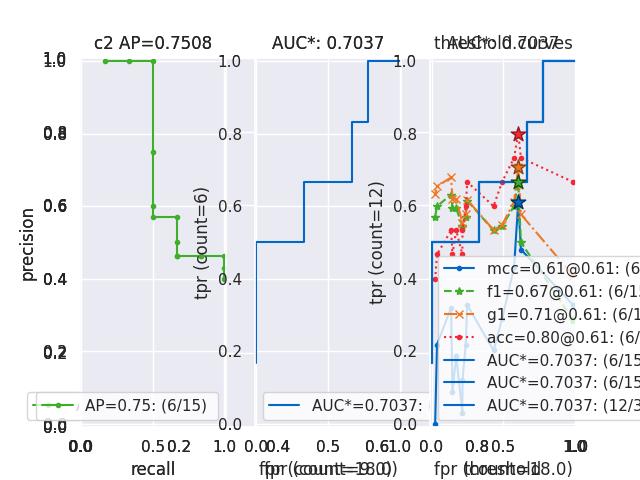
- classmethod combine(tocombine, precision=None, growth=None, thresh_bins=None)[source]
Combine binary confusion metrics
- Parameters:
tocombine (List[Measures]) – a list of measures to combine into one
precision (int | None) – If specified rounds thresholds to this precision which can prevent a RAM explosion when combining a large number of measures. However, this is a lossy operation and will impact the underlying scores. NOTE: use
growthinstead.growth (str | None) – if specified this limits how much the resulting measures are allowed to grow by. If None, growth is unlimited. Otherwise, if growth is ‘max’, the growth is limited to the maximum length of an input. We might make this more numerical in the future.
thresh_bins (int | None) – Force this many threshold bins.
- Returns:
kwcoco.metrics.confusion_measures.Measures
Example
>>> from kwcoco.metrics.confusion_measures import *  # NOQA
>>> measures1 = Measures.demo(n=15)
>>> measures2 = measures1
>>> tocombine = [measures1, measures2]
>>> new_measures = Measures.combine(tocombine)
>>> new_measures.reconstruct()
>>> print('new_measures = {!r}'.format(new_measures))
>>> print('measures1 = {!r}'.format(measures1))
>>> print('measures2 = {!r}'.format(measures2))
>>> print(ub.urepr(measures1.__json__(), nl=1, sort=0))
>>> print(ub.urepr(measures2.__json__(), nl=1, sort=0))
>>> print(ub.urepr(new_measures.__json__(), nl=1, sort=0))
>>> # xdoctest: +REQUIRES(--show)
>>> import kwplot
>>> kwplot.autompl()
>>> kwplot.figure(fnum=1)
>>> new_measures.summary_plot()
>>> measures1.summary_plot()
>>> measures1.draw('roc')
>>> measures2.draw('roc')
>>> new_measures.draw('roc')
Example
>>> # Demonstrate issues that can arrise from choosing a precision
>>> # that is too low  when combining metrics. Breakpoints
>>> # between different metrics can get muddled, but choosing a
>>> # precision that is too high can overwhelm memory.
>>> from kwcoco.metrics.confusion_measures import *  # NOQA
>>> base = ub.map_vals(np.asarray, {
>>>     'tp_count':   [ 1,  1,  2,  2,  2,  2,  3],
>>>     'fp_count':   [ 0,  1,  1,  2,  3,  4,  5],
>>>     'fn_count':   [ 1,  1,  0,  0,  0,  0,  0],
>>>     'tn_count':   [ 5,  4,  4,  3,  2,  1,  0],
>>>     'thresholds': [.0, .0, .0, .0, .0, .0, .0],
>>> })
>>> # Make tiny offsets to thresholds
>>> rng = kwarray.ensure_rng(0)
>>> n = len(base['thresholds'])
>>> offsets = [
>>>     sorted(rng.rand(n) * 10 ** -rng.randint(4, 7))[::-1]
>>>     for _ in range(20)
>>> ]
>>> tocombine = []
>>> for offset in offsets:
>>>     base_n = base.copy()
>>>     base_n['thresholds'] += offset
>>>     measures_n = Measures(base_n).reconstruct()
>>>     tocombine.append(measures_n)
>>> for precision in [6, 5, 2]:
>>>     combo = Measures.combine(tocombine, precision=precision).reconstruct()
>>>     print('precision = {!r}'.format(precision))
>>>     print('combo = {}'.format(ub.urepr(combo, nl=1)))
>>>     print('num_thresholds = {}'.format(len(combo['thresholds'])))
>>> for growth in [None, 'max', 'log', 'root', 'half']:
>>>     combo = Measures.combine(tocombine, growth=growth).reconstruct()
>>>     print('growth = {!r}'.format(growth))
>>>     print('combo = {}'.format(ub.urepr(combo, nl=1)))
>>>     print('num_thresholds = {}'.format(len(combo['thresholds'])))
>>>     #print(combo.counts().pandas())
Example
>>> # Test case: combining a single measures should leave it unchanged
>>> from kwcoco.metrics.confusion_measures import *  # NOQA
>>> measures = Measures.demo(n=40, p_true=0.2, p_error=0.4, p_miss=0.6)
>>> df1 = measures.counts().pandas().fillna(0)
>>> print(df1)
>>> tocombine = [measures]
>>> combo = Measures.combine(tocombine)
>>> df2 = combo.counts().pandas().fillna(0)
>>> print(df2)
>>> assert np.allclose(df1, df2)
>>> combo = Measures.combine(tocombine, thresh_bins=2)
>>> df3 = combo.counts().pandas().fillna(0)
>>> print(df3)
>>> # I am NOT sure if this is correct or not
>>> thresh_bins = 20
>>> combo = Measures.combine(tocombine, thresh_bins=thresh_bins)
>>> df4 = combo.counts().pandas().fillna(0)
>>> print(df4)
>>> combo = Measures.combine(tocombine, thresh_bins=np.linspace(0, 1, 20))
>>> df4 = combo.counts().pandas().fillna(0)
>>> print(df4)
assert np.allclose(combo[‘thresholds’], measures[‘thresholds’]) assert np.allclose(combo[‘fp_count’], measures[‘fp_count’]) assert np.allclose(combo[‘tp_count’], measures[‘tp_count’]) assert np.allclose(combo[‘tp_count’], measures[‘tp_count’])
globals().update(xdev.get_func_kwargs(Measures.combine))
Example
>>> # Test degenerate case
>>> from kwcoco.metrics.confusion_measures import *  # NOQA
>>> tocombine = [
>>>     {'fn_count': [0.0], 'fp_count': [359980.0], 'thresholds': [0.0], 'tn_count': [0.0], 'tp_count': [7747.0]},
>>>     {'fn_count': [0.0], 'fp_count': [360849.0], 'thresholds': [0.0], 'tn_count': [0.0], 'tp_count': [424.0]},
>>>     {'fn_count': [0.0], 'fp_count': [367003.0], 'thresholds': [0.0], 'tn_count': [0.0], 'tp_count': [991.0]},
>>>     {'fn_count': [0.0], 'fp_count': [367976.0], 'thresholds': [0.0], 'tn_count': [0.0], 'tp_count': [1017.0]},
>>>     {'fn_count': [0.0], 'fp_count': [676338.0], 'thresholds': [0.0], 'tn_count': [0.0], 'tp_count': [7067.0]},
>>>     {'fn_count': [0.0], 'fp_count': [676348.0], 'thresholds': [0.0], 'tn_count': [0.0], 'tp_count': [7406.0]},
>>>     {'fn_count': [0.0], 'fp_count': [676626.0], 'thresholds': [0.0], 'tn_count': [0.0], 'tp_count': [7858.0]},
>>>     {'fn_count': [0.0], 'fp_count': [676693.0], 'thresholds': [0.0], 'tn_count': [0.0], 'tp_count': [10969.0]},
>>>     {'fn_count': [0.0], 'fp_count': [677269.0], 'thresholds': [0.0], 'tn_count': [0.0], 'tp_count': [11188.0]},
>>>     {'fn_count': [0.0], 'fp_count': [677331.0], 'thresholds': [0.0], 'tn_count': [0.0], 'tp_count': [11734.0]},
>>>     {'fn_count': [0.0], 'fp_count': [677395.0], 'thresholds': [0.0], 'tn_count': [0.0], 'tp_count': [11556.0]},
>>>     {'fn_count': [0.0], 'fp_count': [677418.0], 'thresholds': [0.0], 'tn_count': [0.0], 'tp_count': [11621.0]},
>>>     {'fn_count': [0.0], 'fp_count': [677422.0], 'thresholds': [0.0], 'tn_count': [0.0], 'tp_count': [11424.0]},
>>>     {'fn_count': [0.0], 'fp_count': [677648.0], 'thresholds': [0.0], 'tn_count': [0.0], 'tp_count': [9804.0]},
>>>     {'fn_count': [0.0], 'fp_count': [677826.0], 'thresholds': [0.0], 'tn_count': [0.0], 'tp_count': [2470.0]},
>>>     {'fn_count': [0.0], 'fp_count': [677834.0], 'thresholds': [0.0], 'tn_count': [0.0], 'tp_count': [2470.0]},
>>>     {'fn_count': [0.0], 'fp_count': [677835.0], 'thresholds': [0.0], 'tn_count': [0.0], 'tp_count': [2470.0]},
>>>     {'fn_count': [11123.0, 0.0], 'fp_count': [0.0, 676754.0], 'thresholds': [0.0002442002442002442, 0.0], 'tn_count': [676754.0, 0.0], 'tp_count': [2.0, 11125.0]},
>>>     {'fn_count': [7738.0, 0.0], 'fp_count': [0.0, 676466.0], 'thresholds': [0.0002442002442002442, 0.0], 'tn_count': [676466.0, 0.0], 'tp_count': [0.0, 7738.0]},
>>>     {'fn_count': [8653.0, 0.0], 'fp_count': [0.0, 676341.0], 'thresholds': [0.0002442002442002442, 0.0], 'tn_count': [676341.0, 0.0], 'tp_count': [0.0, 8653.0]},
>>> ]
>>> thresh_bins = np.linspace(0, 1, 4)
>>> combo = Measures.combine(tocombine, thresh_bins=thresh_bins).reconstruct()
>>> print('tocombine = {}'.format(ub.urepr(tocombine, nl=2)))
>>> print('thresh_bins = {!r}'.format(thresh_bins))
>>> print(ub.urepr(combo.__json__(), nl=1))
>>> for thresh_bins in [4096, 1]:
>>>     combo = Measures.combine(tocombine, thresh_bins=thresh_bins).reconstruct()
>>>     print('thresh_bins = {!r}'.format(thresh_bins))
>>>     print('combo = {}'.format(ub.urepr(combo, nl=1)))
>>>     print('num_thresholds = {}'.format(len(combo['thresholds'])))
>>> for precision in [6, 5, 2]:
>>>     combo = Measures.combine(tocombine, precision=precision).reconstruct()
>>>     print('precision = {!r}'.format(precision))
>>>     print('combo = {}'.format(ub.urepr(combo, nl=1)))
>>>     print('num_thresholds = {}'.format(len(combo['thresholds'])))
>>> for growth in [None, 'max', 'log', 'root', 'half']:
>>>     combo = Measures.combine(tocombine, growth=growth).reconstruct()
>>>     print('growth = {!r}'.format(growth))
>>>     print('combo = {}'.format(ub.urepr(combo, nl=1)))
>>>     print('num_thresholds = {}'.format(len(combo['thresholds'])))
- kwcoco.metrics.confusion_measures._combine_threshold(tocombine_thresh, thresh_bins, growth, precision)[source]
Logic to take care of combining thresholds in the case bins are not given
This can be fairly slow and lead to unnecessary memory usage
- kwcoco.metrics.confusion_measures.reversable_diff(arr, assume_sorted=1, reverse=False)[source]
Does a reversible array difference operation.
This will be used to find positions where accumulation happened in confusion count array.
- Parameters:
arr (ndarray) – Input sequence (finite interior; may have +/-inf at ends).
assume_sorted (int) – Reserved; asserts the monotone assumption. Default is True.
reverse (bool) – If True, treat
arras reversed; outputs are adjusted accordingly. Defaults to False.
- Returns:
- Tuple[np.ndarray, np.ndarray, np.ndarray]
(diff_arr, prefix, suffix). To invert: - ifreverse=False:recon = np.cumsum(diff_arr); recon[:len(prefix)] += prefix; recon[-len(suffix):] += suffixif
reverse=True: apply the same idea with reversed arrays.
- class kwcoco.metrics.confusion_measures.PerClass_Measures(cx_to_info)[source]
-
A container class mapping categories to
Measures.- draw(key='mcc', prefix='', **kw)[source]
Example
>>> # xdoctest: +REQUIRES(module:kwplot)
>>> from kwcoco.metrics.confusion_vectors import ConfusionVectors  # NOQA
>>> cfsn_vecs = ConfusionVectors.demo()
>>> ovr_cfsn = cfsn_vecs.binarize_ovr(keyby='name')
>>> self = ovr_cfsn.measures()['perclass']
>>> self.draw('mcc', doclf=True, fnum=1)
>>> self.draw('pr', doclf=1, fnum=2)
>>> self.draw('roc', doclf=1, fnum=3)
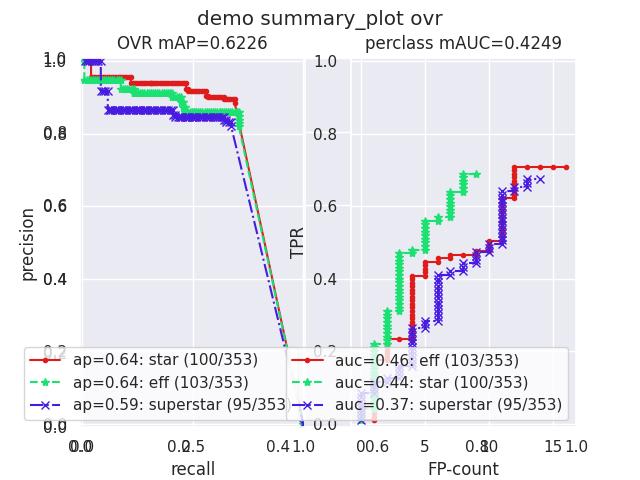
- summary_plot(fnum=1, title='', subplots='auto')[source]
CommandLine
python ~/code/kwcoco/kwcoco/metrics/confusion_measures.py PerClass_Measures.summary_plot --show
Example
>>> from kwcoco.metrics.confusion_measures import *  # NOQA
>>> from kwcoco.metrics.detect_metrics import DetectionMetrics
>>> dmet = DetectionMetrics.demo(
>>>     n_fp=(0, 1), n_fn=(0, 3), nimgs=32, nboxes=(0, 32),
>>>     classes=3, rng=0, newstyle=1, box_noise=0.7, cls_noise=0.2, score_noise=0.3, with_probs=False)
>>> cfsn_vecs = dmet.confusion_vectors()
>>> ovr_cfsn = cfsn_vecs.binarize_ovr(keyby='name', ignore_classes=['vector', 'raster'])
>>> self = ovr_cfsn.measures()['perclass']
>>> # xdoctest: +REQUIRES(--show)
>>> import kwplot
>>> kwplot.autompl()
>>> import seaborn as sns
>>> sns.set()
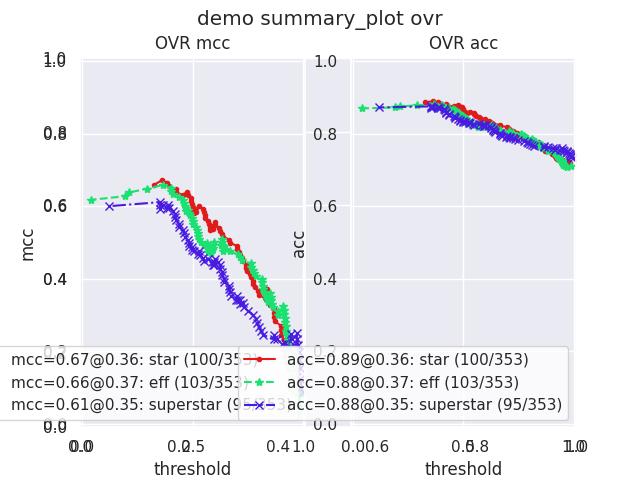
>>> self.summary_plot(title='demo summary_plot ovr', subplots=['pr', 'roc'])
>>> kwplot.show_if_requested()
>>> self.summary_plot(title='demo summary_plot ovr', subplots=['mcc', 'acc'], fnum=2)
- class kwcoco.metrics.confusion_measures.MeasureCombiner(precision=None, growth=None, thresh_bins=None)[source]
Bases:
objectHelper to iteravely combine binary measures generated by some process
Example
>>> from kwcoco.metrics.confusion_measures import *  # NOQA
>>> from kwcoco.metrics.confusion_vectors import BinaryConfusionVectors
>>> rng = kwarray.ensure_rng(0)
>>> bin_combiner = MeasureCombiner(growth='max')
>>> for _ in range(80):
>>>     bin_cfsn_vecs = BinaryConfusionVectors.demo(n=rng.randint(40, 50), rng=rng, p_true=0.2, p_error=0.4, p_miss=0.6)
>>>     bin_measures = bin_cfsn_vecs.measures()
>>>     bin_combiner.submit(bin_measures)
>>> combined = bin_combiner.finalize()
>>> print('combined = {!r}'.format(combined))
- Parameters:
precision (None | int) – deprecated use growth or thresh_bins instead.
growth (str | None) – if specified this limits how much the resulting measures are allowed to grow by. If None, growth is unlimited. Otherwise, if growth is ‘max’, the growth is limited to the maximum length of an input. We might make this more numerical in the future.
thresh_bins (int | List[float] | None) – If an integer force this many threshold bins, or if a list then use these threshold bins.
- property queue_size
- class kwcoco.metrics.confusion_measures.OneVersusRestMeasureCombiner(precision=None, growth=None, thresh_bins=None)[source]
Bases:
objectHelper to iteravely combine ovr measures generated by some process
Example
>>> from kwcoco.metrics.confusion_measures import *  # NOQA
>>> from kwcoco.metrics.confusion_vectors import OneVsRestConfusionVectors
>>> rng = kwarray.ensure_rng(0)
>>> ovr_combiner = OneVersusRestMeasureCombiner(growth='max')
>>> for _ in range(80):
>>>     ovr_cfsn_vecs = OneVsRestConfusionVectors.demo()
>>>     ovr_measures = ovr_cfsn_vecs.measures()
>>>     ovr_combiner.submit(ovr_measures)
>>> combined = ovr_combiner.finalize()
>>> print('combined = {!r}'.format(combined))